
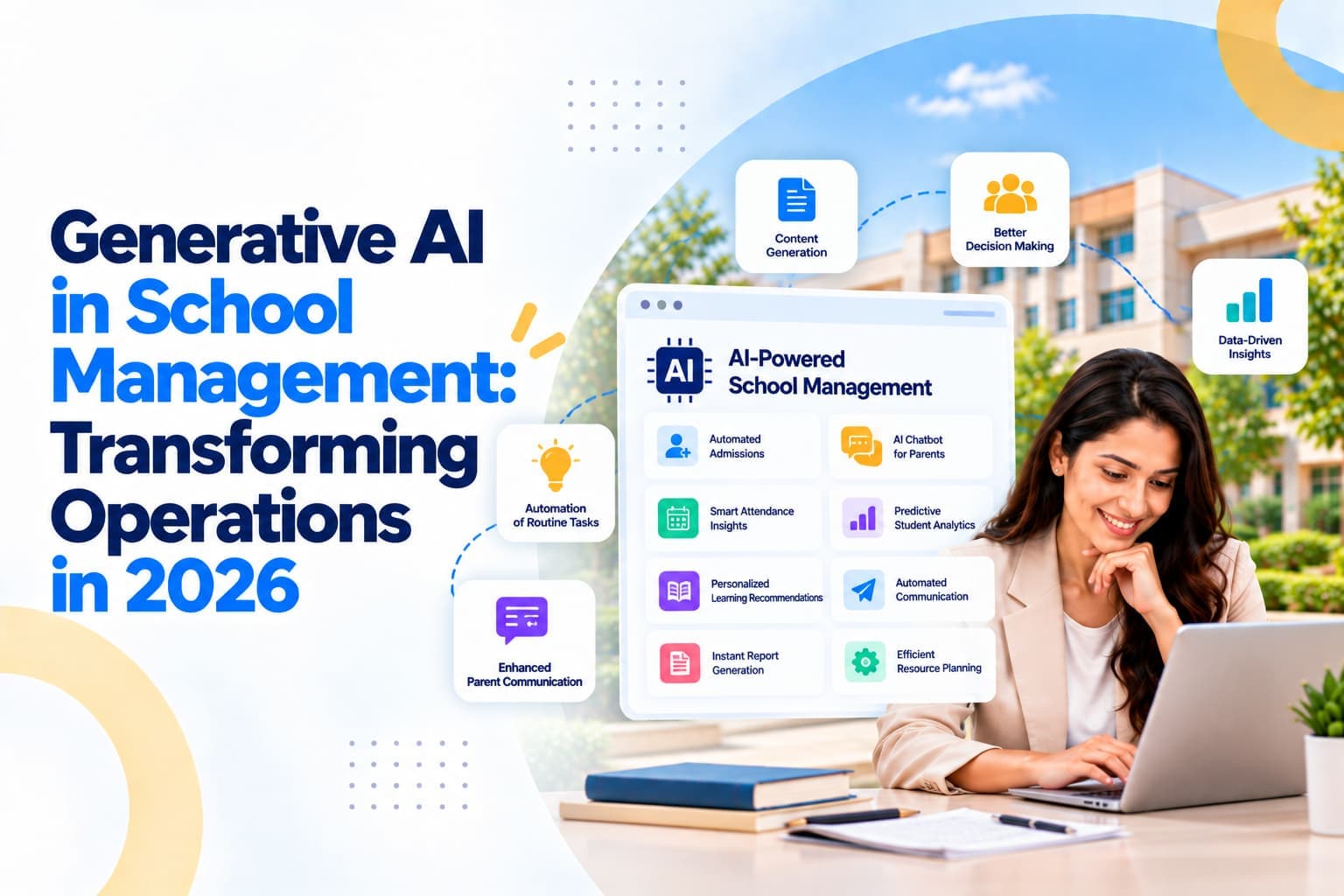
Generative AI is transforming how schools manage administration, communication, reporting, and everyday operations in 2026. From drafting school communications to summarizing data and supporting faster decision-making, AI is helping school administrators reduce repetitive work and focus more on tasks that require human judgment. For school leaders, the real opportunity is not simply using AI to complete individual tasks, but integrating it into workflows that save time and improve how schools operate.
Generative AI can help administrators create documents, summarize information, organize communication, identify patterns, and support faster decision-making. When combined with the right digital infrastructure, it can become a practical assistant for school teams rather than another standalone technology.
This shift is also changing expectations around school technology. Modern school management software needs to do more than store student records. It should help administrators understand information, reduce repetitive work, and respond efficiently to changing school requirements.
What Is Generative AI in School Management?
Generative AI refers to artificial intelligence systems that can create or transform content based on instructions and available information. In a school environment, this can include generating notices, summarizing reports, drafting parent communications, organizing meeting information, and helping administrators interpret large amounts of data.
Unlike traditional automation, which generally follows predefined rules, generative AI can work with natural-language instructions and produce context-specific outputs.
For example, instead of manually preparing a parent announcement, an administrator could provide the important details and ask an AI assistant to create a clear draft. The administrator can then review and approve it before sharing.
This combination of automation and human oversight makes AI particularly useful for repetitive administrative work.
Why Are Schools Exploring AI in 2026?
School administrators manage multiple responsibilities every day. Attendance, student records, staff coordination, parent communication, academic reporting, events, fee-related information, and documentation can create a significant administrative workload.
AI can help reduce the time spent on repetitive activities while allowing staff to focus on tasks that require human judgment.
Three major factors are driving adoption:
1. Growing Amounts of School Data
Schools generate information from attendance, assessments, student records, communication, and daily operations. AI can help organize and summarize this information so administrators can identify useful insights more quickly.
2. Demand for Faster Communication
Parents and students expect timely updates. AI can assist with drafting announcements, reminders, notifications, and other communications while maintaining a consistent structure.
3. Pressure to Improve Administrative Efficiency
Schools want technology that does more than digitize existing processes. They increasingly need tools that reduce repetitive work and help staff make better use of available information.
Key Use Cases of Generative AI in School Management
AI tools for school administrators can support several areas of school operations, from communication and reporting to data analysis and routine administrative tasks.
1. Automated School Communication
Creating notices and messages can consume considerable administrative time. AI can help draft announcements for events, schedule changes, meetings, holidays, examinations, and other school activities.
Administrators can provide the essential information, review the generated message, and publish the final version through the appropriate communication channel.
This can improve consistency while reducing the effort required to create routine communications.
2. Student Data Summarization
School administrators may need to review information from multiple sources before understanding a student's academic or attendance situation.
AI can summarize relevant data into a simpler format, helping staff quickly identify important patterns. For example, a summary could highlight attendance changes, academic performance trends, or areas requiring additional attention.
AI should support this process rather than make important decisions independently. Final interpretation should remain with qualified school staff.
3. Report and Document Creation
Schools regularly prepare reports, meeting notes, summaries, circulars, and administrative documents.
Generative AI can create initial drafts from structured information, reducing repetitive writing. Staff can then verify facts, make changes, and approve the final document.
This approach can be especially useful for administrators who regularly prepare similar documents with different information.
4. Parent and Teacher Support
AI can help school teams prepare responses to frequently asked questions and routine requests. It can also organize information so teachers and administrators can find relevant details more efficiently.
For example, an AI assistant could help draft a response about an upcoming examination, school event, attendance policy, or required document.
Human review remains important, particularly when communication involves sensitive student information.
5. Administrative Data Insights
AI can make large datasets easier to understand by converting complex information into summaries and observations.
An administrator could ask for a summary of attendance trends, identify unusual changes, or review performance information across different groups.
This can support data-informed decision-making without requiring every administrator to manually analyze large spreadsheets or reports.
How AI Dashboards Can Improve School Administration
One of the most useful developments is the integration of AI with dashboards.
Traditional dashboards display information such as attendance percentages, student counts, fee status, academic results, or staff information. AI can make these dashboards more interactive by helping administrators interpret the information.
An AI dashboard for school administrators can potentially provide summaries, highlight unusual trends, and surface information that deserves attention.
For example, instead of simply showing an attendance chart, an AI-enabled dashboard could summarize that attendance has declined over a particular period and identify the relevant classes or groups for further review.
The goal is not to replace dashboards but to make the information within them easier to understand and act upon.
Benefits of AI for Schools
When implemented responsibly, generative AI can provide several practical benefits.
- Reduced Administrative Work: Routine drafting, summarization, and information-processing tasks can take less time when AI assists staff.
- Faster Decision Support: AI can organize large amounts of information into understandable summaries, helping administrators reach relevant information more quickly.
- Consistent Communication: AI-generated drafts can help schools maintain a consistent structure and tone across routine announcements and communications.
- Better Use of School Data: Schools already collect significant amounts of operational data. AI can help transform that information into useful observations rather than leaving it in disconnected reports.
- Improved Staff Productivity: When repetitive tasks require less manual effort, teachers and administrators can dedicate more time to students, planning, and activities that require human expertise.
Choosing the Right AI-Enabled School Technology
Schools should evaluate AI capabilities based on practical requirements, data security, usability, and how well they fit existing workflows rather than choosing technology simply because it includes AI.
An AI School Management Software solution should complement existing school workflows and make information easier to manage. It should also help administrators reduce repetitive tasks while making important information easier to access.
When evaluating a school management system with AI, schools should look for practical features that connect administrative information with everyday workflows and support staff productivity.
Before adopting a platform, schools should consider:
- Data privacy and security
- User access controls
- Accuracy of AI-generated information
- Integration with existing systems
- Ease of use for teachers and administrators
- Human review and approval processes
- Reporting and analytics capabilities
- Transparency around how AI features are used
The best technology should solve real administrative problems instead of adding unnecessary complexity.
Risks and Challenges of Generative AI in Schools
AI also introduces important risks that schools need to consider.
- Data Privacy: Student records and school information can be highly sensitive. Schools should understand where data is processed, how it is stored, and who can access it before using AI-based services.
- Inaccurate Information: Generative AI can produce incorrect or misleading information. AI-generated content should therefore be reviewed before it is used for important communication or decision-making.
- Over-Reliance on Automation: AI should assist school staff rather than replace professional judgment. Decisions involving students, teachers, or sensitive situations require appropriate human involvement.
- Lack of Transparency: Teachers and administrators should understand when AI is being used and what role it plays in a workflow. Clear policies can help establish responsible usage.
- Implementation Challenges: Introducing AI requires more than purchasing software. Schools may need staff training, clear guidelines, access controls, and a phased implementation strategy.
The Future of AI-Powered School Management
The next generation of school technology is likely to combine automation, analytics, and AI assistance within a single ecosystem.
An AI-powered school management system can potentially connect administrative data with intelligent assistance, allowing schools to move from simply recording information to actively using it.
For example, future systems may provide personalized administrative summaries, identify operational trends, generate communication drafts, and help staff access relevant information through natural-language interactions.
However, successful adoption will depend on responsible implementation. Schools should prioritize privacy, accuracy, transparency, and human oversight while introducing AI into daily operations.
Final Thoughts
Generative AI is becoming an important part of the conversation around school management in 2026. Its biggest value may not come from replacing existing roles, but from helping school teams reduce repetitive work, understand information faster, and communicate more efficiently.
Schools that adopt AI strategically can build more efficient workflows while keeping educators and administrators at the center of important decisions.
The future of school management technology is therefore likely to be more intelligent, connected, and data-driven. But technology alone will not transform school administration. The strongest results will come when AI capabilities are combined with reliable systems, responsible policies, trained staff, and a clear focus on improving the experience of students, teachers, administrators, and parents.
Padhalo Editorial Team
September 29, 2026