

Homework is an important part of the learning process. It helps students revise classroom concepts, practice essential skills, and develop independent learning habits. However, many schools struggle with incomplete assignments, missed deadlines, and students who regularly forget their homework.
These challenges can affect academic progress and create additional work for teachers and parents. Simply assigning more homework or sending frequent reminders does not always solve the problem. Schools need practical systems that make assignments easier to understand, organize, complete, and monitor.
By improving communication, setting realistic expectations, and using appropriate technology, schools can encourage students to take greater responsibility for their learning. This article explores six practical strategies that teachers and school administrators can implement to improve homework completion rates and create a more organized learning environment.
Why Do Students Struggle to Complete Homework?
Before introducing new solutions, schools should understand why students leave assignments unfinished. Identifying the reasons behind incomplete work helps teachers provide the right support instead of relying only on reminders or penalties.
Some common challenges include:
Unclear instructions
Students may not understand assignment requirements or expected outcomes.
Poor time management
Students may struggle to balance homework with extracurriculars and family duties.
Heavy workloads
Multiple assignments with overlapping deadlines can quickly overwhelm learners.
Lack of motivation
Repetitive or overly difficult tasks reduce curiosity and enthusiasm for study.
Communication gaps
Parents may not know which tasks are pending or when they are due.
Limited academic support
Students struggling with specific subjects need clear, timely guidance.
Schools should also consider whether homework is appropriate for students' ages, abilities, and available resources. Understanding these factors makes it easier to create effective solutions that support learning without adding unnecessary pressure.
1. Set Clear Instructions and Realistic Deadlines
Students are more likely to achieve student homework completion when they understand exactly what they need to do and when they must submit their work.
Teachers should provide specific instructions, explain the expected outcome, and communicate deadlines clearly. For example, instead of asking students to revise an entire science chapter without further guidance, a teacher could assign five questions from a particular section and specify the submission date.
Schools should also coordinate assignments across subjects. When several teachers assign lengthy tasks for the same evening, students may find it difficult to manage their workload effectively.
Practical steps schools can follow:
- Break complex assignments into smaller, manageable tasks.
- Explain the purpose and expected outcome of each assignment.
- Provide examples when students may need additional clarification.
- Set realistic deadlines according to students' age and grade level.
- Coordinate homework schedules across different subjects.
Clear expectations reduce confusion and help students organize their time more effectively. Teachers should also allow students to ask questions before leaving the classroom so that they can begin their assignments with confidence.
When assignments are structured properly, students can focus on understanding the subject instead of trying to figure out what the teacher expects.
2. Develop Consistent Homework Routines
A regular study routine helps students develop discipline and manage their academic responsibilities independently. Without a consistent schedule, homework can become a last-minute activity that competes with entertainment, sports, and other commitments.
Schools can encourage students to review their assignments after school, prioritise tasks, and allocate sufficient time for independent study. Parents can support these habits by providing a quiet study space and helping children organize their school materials.
For younger students, shorter study sessions with breaks may be more suitable. Older students can gradually learn to manage their schedules independently.
Ways to build effective routines include:
- Encourage students to review their homework every day.
- Recommend a consistent study time that fits their daily schedule.
- Use planners or checklists to organize assignments.
- Teach students to prioritise tasks according to deadlines.
- Encourage them to prepare books and learning materials in advance.
Teachers should explain that routines need to be realistic. A simple schedule followed consistently is more effective than an ambitious plan that becomes difficult to maintain.
Parents should also avoid completing assignments for their children. Instead, they can provide guidance, answer questions where appropriate, and encourage students to take ownership of their work.
Over time, these habits can strengthen self-discipline, improve organization, and make homework a more manageable part of everyday learning.
3. Make Homework Interesting and Relevant
Students may lose interest in homework when assignments feel repetitive or disconnected from real-life situations. Teachers can make learning more engaging by designing activities that connect classroom concepts with everyday experiences.
For example, a mathematics teacher could ask students to calculate the total cost of items on a shopping list. A science teacher might assign a simple observation activity, while an English teacher could ask students to write a short paragraph about a personal experience.
These activities help students understand why they are learning a particular concept.
Ideas for engaging homework include:
- Practical exercises based on everyday situations.
- Creative writing and problem-solving activities.
- Reading assignments followed by discussion questions.
- Small research projects using age-appropriate resources.
- Optional challenge questions for students who want additional practice.
Teachers should ensure that assignments remain connected to curriculum objectives and can be completed using resources available to students at home.
It is also important to avoid assigning excessive work simply to keep students occupied. Homework should reinforce classroom learning, develop useful skills, and encourage curiosity.
When students understand the purpose of an assignment and find it appropriately challenging, they may become more motivated to complete it on time.
4. Improve Communication Between Teachers and Parents
Parents play an important role in supporting their children's education. However, they cannot provide effective assistance when they do not know which assignments are pending, what the deadlines are, or whether their child is experiencing difficulties.
Schools should establish a consistent communication process that keeps parents informed about homework requirements and academic progress.
This can include student planners, parent-teacher meetings, dedicated school communication platforms, email, or modern parent portals. The chosen method should make information easy to access and understand.
Effective communication practices include:
- Share assignment details and deadlines clearly.
- Notify parents when incomplete work becomes a recurring concern.
- Provide constructive feedback on students' progress.
- Explain how parents can support learning at home.
- Encourage parents to report difficulties that may affect assignment completion.
Communication should be supportive rather than punitive. If a student repeatedly misses deadlines, teachers and parents should work together to identify the underlying problem and agree on appropriate solutions.
Schools can also schedule regular progress reviews to discuss academic challenges and determine whether additional support is required.
A strong partnership between teachers and parents creates a more consistent learning environment and helps students develop greater responsibility for their academic performance.
5. Use Digital Tools to Manage Assignments
Managing homework manually can become challenging as schools handle multiple classes, subjects, teachers, and deadlines. Paper registers and separate messaging groups may make it difficult to maintain accurate records and identify missing assignments quickly.
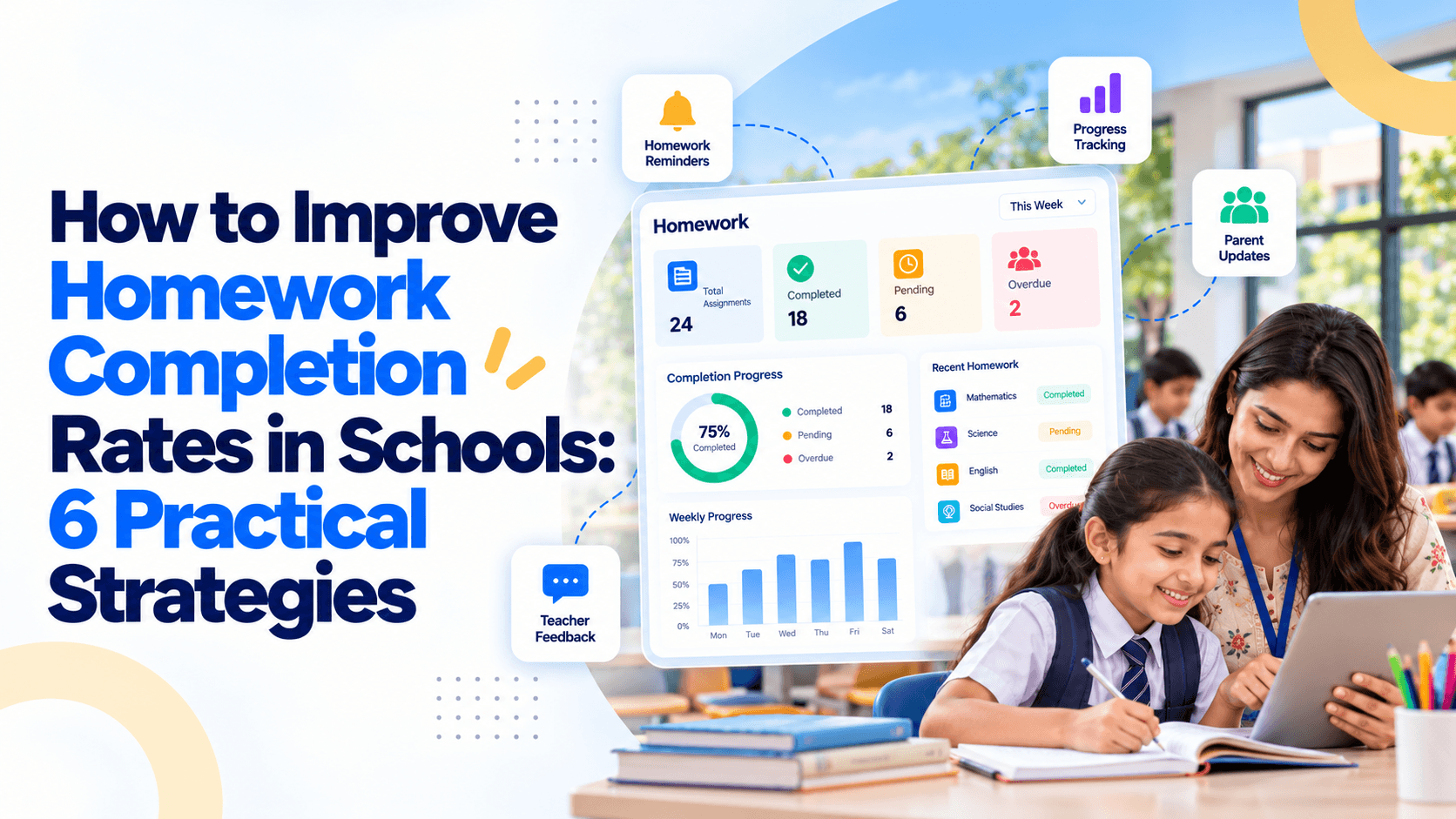
A digital platform can simplify these processes by bringing assignment creation, deadline management, submission monitoring, and communication into one organized system.
For institutions exploring school homework management software, useful features may include:
Teachers can share instructions, learning materials, and submission dates easily.
Students and parents receive automated reminders about upcoming submissions.
Teachers can view completed, pending, and overdue work in real time.
Parents can review homework details and follow their child's daily academic progress.
Effective student assignment tracking also helps teachers understand whether particular subjects, classes, or assignment types are associated with repeated delays.
For example, if a teacher notices that several students regularly miss deadlines for a particular subject, the school can investigate whether the workload is excessive or additional academic guidance is needed.
When selecting a digital solution, schools should prioritise ease of use, reliable reporting, data security, and compatibility with existing school processes.
Technology should support teachers rather than create additional administrative work. When implemented thoughtfully, digital tools can improve visibility, reduce manual follow-ups, and give teachers more time to focus on student learning.
6. Monitor Progress and Recognize Student Effort
Students benefit from regular feedback because it helps them understand their progress and identify areas for improvement. Schools should therefore monitor assignment completion and recognize consistent effort, not just high academic scores.
Teachers can maintain simple records of submitted assignments, identify recurring difficulties, and discuss achievable improvement goals with students.
Practical approaches include:
- Review homework completion every week.
- Identify students who frequently miss deadlines.
- Provide timely and constructive feedback.
- Set individual improvement goals.
- Recognize consistent effort and responsible behaviour.
- Offer additional academic support when necessary.
Recognition does not always require prizes or expensive rewards. Positive feedback, classroom appreciation, and personal progress goals can encourage students to develop better study habits.
Schools should avoid publicly comparing students or embarrassing those who submit work late. Such practices may reduce confidence and discourage students from seeking help.
Instead, teachers should focus on progress, accountability, and individual improvement. A student who gradually becomes more consistent deserves recognition, even if they are not yet completing every assignment on time.
Regular monitoring also helps schools evaluate whether their existing homework completion strategies for schools are effective and where adjustments may be necessary.
How Schools Can Reduce Late Homework Submissions
Although the six strategies above address common homework challenges, some students may continue to miss deadlines. Schools should follow a structured process to reduce late homework submissions, understand individual situations, and provide appropriate support.
Record incomplete assignments
Maintain an accurate record of missing and overdue work across classes.
Identify recurring patterns
Determine whether delays are linked to particular subjects, deadlines, or assignment types.
Communicate early
Inform students and parents before incomplete assignments accumulate into academic setbacks.
Provide targeted support
Clarify instructions, adjust workloads where appropriate, or offer additional academic guidance.
Review progress
Evaluate whether agreed actions improve future submissions and adjust strategies accordingly.
Schools should apply these steps consistently while allowing reasonable flexibility for genuine difficulties.
If many students struggle to complete assignments, administrators should also review the overall workload. Better coordination between teachers may be more effective than introducing additional reminders or stricter penalties.
The objective is to encourage responsibility while ensuring that homework remains a useful part of the learning process.
How to Measure Homework Completion Improvements
Schools should track meaningful indicators to understand whether their efforts are producing positive results. Reviewing performance regularly helps administrators identify successful practices and areas that need further attention.
| Metric | What It Measures |
|---|---|
| On-time submission rate | Percentage of assignments submitted before the deadline |
| Missing assignment rate | Frequency of incomplete or unsubmitted work |
| Average submission delay | How long students take to submit overdue assignments |
| Parent communication | Whether families receive and respond to important updates |
| Student participation | Engagement with assigned learning activities |
| Teacher follow-up time | Time spent monitoring and reminding students |
Schools can establish a baseline using existing records and review these indicators monthly. For example, if on-time submissions improve after introducing deadline reminders, administrators can evaluate whether the approach should be continued.
If particular classes continue to experience difficulties, teachers can investigate workload, assignment clarity, and student support requirements.
The goal should not be to increase completion numbers at any cost. Homework should support understanding, independent learning, and student well-being.
Conclusion
Improving homework habits requires a structured approach that combines clear instructions, realistic deadlines, engaging assignments, consistent routines, parent communication, and regular progress reviews.
Digital tools can further simplify assignment monitoring and help schools identify students who need additional support. However, technology works best when combined with effective teaching practices and a supportive learning environment.
By adopting a practical approach to homework management for schools, administrators can improve assignment visibility, reduce unnecessary follow-ups, and help students become more responsible learners.
Start by identifying the most common homework challenges in your school, introduce a few targeted improvements, and measure the results regularly. With consistent support from teachers and parents, students can develop stronger study habits and manage their academic responsibilities with greater confidence.
Padhalo Editorial Team
October 27, 2026